How to Source Tempered Glass Screen Protectors Wholesale: A Factory-Direct Guide
Sourcing screen protectors looks simple from the outside.
Find a supplier. Agree a price. Place an order.
In practice, the sourcing decision is the single biggest lever in your wholesale margin, your product quality, and your ability to compete in retail. Get it right and you have a sustainable, repeatable distribution business. Get it wrong — buying from the wrong tier of the supply chain, paying for quality you are not getting, or locking into a supplier with no logistics capability — and margin disappears before the product reaches the shelf.
This guide covers how sourcing actually works for tempered glass screen protectors: the supply chain, the supplier types, what separates a strong factory-direct partner from a trading intermediary, and the sequence you should follow before placing your first bulk order.
Why Your Sourcing Model Determines Your Margin
Most wholesale buyers focus on unit price. The sharper question is where that price originates.
A screen protector priced at RMB 8 from a trading company and RMB 8 from a factory are not the same thing. The factory is at cost. The trading company has already built their margin in — typically 15–25% above what the manufacturer charged them.
Sourcing one tier back in the supply chain can add 10–20 percentage points to your gross margin without changing a single thing about your sell price to retailers.
That is the structural argument for factory-direct sourcing. Everything else — quality, lead times, customisation — is secondary to this core point. The further you sit from the factory, the thinner your margin.
How the Screen Protector Supply Chain Works
Understanding the chain clarifies where you should be buying. The full supply chain moves from raw material suppliers through to the tempered glass manufacturer (factory), then optionally through a trading company or importer, then to you as the wholesale distributor, then to retailers and resellers, and finally to the end consumer.
Each step in that chain represents a margin taken. Every layer between you and the factory is margin you are not keeping. The goal for a distributor is to operate at the factory level — sourcing directly from the manufacturer, without intermediaries between the production cost and your landed cost.
The 4 Types of Suppliers (And Which One to Work With)
Not every business that sells screen protectors in bulk is a manufacturer. Understanding the difference matters before you start requesting quotes.
1.Trading Companies
Trading companies buy from multiple factories and resell to buyers who need smaller volumes or consolidated orders. They provide a useful service for very small buyers — lower MOQs, less complexity — but at a cost. Their margin sits between you and the factory.
For a distributor building a meaningful volume business, a trading company is the wrong tier. The price you pay is not factory cost. It is factory cost plus their margin, presented as a market rate.
When they are acceptable: sampling across many product types before committing to a factory relationship. Never for volume purchasing.
2. Domestic Importers and Distributors
These are businesses in your home market who have already imported the product and hold local stock. Fast delivery. Low MOQ. But you are paying the full importer margin — typically 30–50% above the price you would pay buying direct.
When they are acceptable: emergency restocking when your main supply is in transit. Never as your primary source.
3. Factory-Direct Manufacturers
This is where you want to be.
A factory-direct manufacturer produces the glass, applies the coatings, assembles the packaging, and ships to your freight forwarder or direct to your market. No intermediary. No additional margin layer.
The tradeoff is scale: factories work with MOQs. Most reputable tempered glass manufacturers operate with minimum order quantities of 200–500 units per SKU for standard models, higher for custom packaging. Volume pricing tiers improve materially at 1,000+ units.
This is the right sourcing tier for any serious wholesale distributor.
4. OEM / Private Label Manufacturers
A subset of factory-direct, OEM suppliers produce product to your specification — your brand name, your packaging design, your colour scheme. Higher upfront cost (tooling, design, minimum volumes per custom SKU) but full brand ownership of the product.
When they make sense: once you have established volume and want to build a branded product line, not for first orders.
What to Look for in a Factory-Direct Supplier
Once you have identified that you want factory-direct, the next question is which factory. Not all manufacturers are equivalent. These are the criteria that matter.
Product Range and SKU Depth
A strong manufacturer covers the handset models that matter in your market. For Australia, that means current iPhone models (last 3 generations), Samsung Galaxy S and A series, and the dominant mid-range Android devices.
Beyond compatibility, look at product line breadth: clear tempered glass, privacy glass, anti-blue light, ultra-thin, dual-pack kits. A factory that makes only one product type will limit your ability to build a product range that serves different retail channels.
Quality Certifications and QC Process
The 9H hardness rating printed on every box is not automatically meaningful. It needs to be backed by a documented testing process — drop tests at a defined height, hardness testing against the Mohs scale, adhesion testing for oleophobic coating, and inspection protocols for clarity and edge sealing.
Ask any prospective factory: What does your drop test protocol involve? What is your defect rate per production run?
A factory that cannot answer these questions is not a factory you want to source from at volume.
MOQ and Volume Flexibility
MOQ structures vary. Some factories require 1,000 units as a starting point. Others will work with 200–300 units per SKU to accommodate distributors building a range.Understand the MOQ before deep engagement. Also understand the volume tiers — what do you unlock at 500 units, at 1,000, at 2,000? The unit cost differential between tier 1 and tier 3 often determines whether the product margin is viable in your market.
Packaging Options
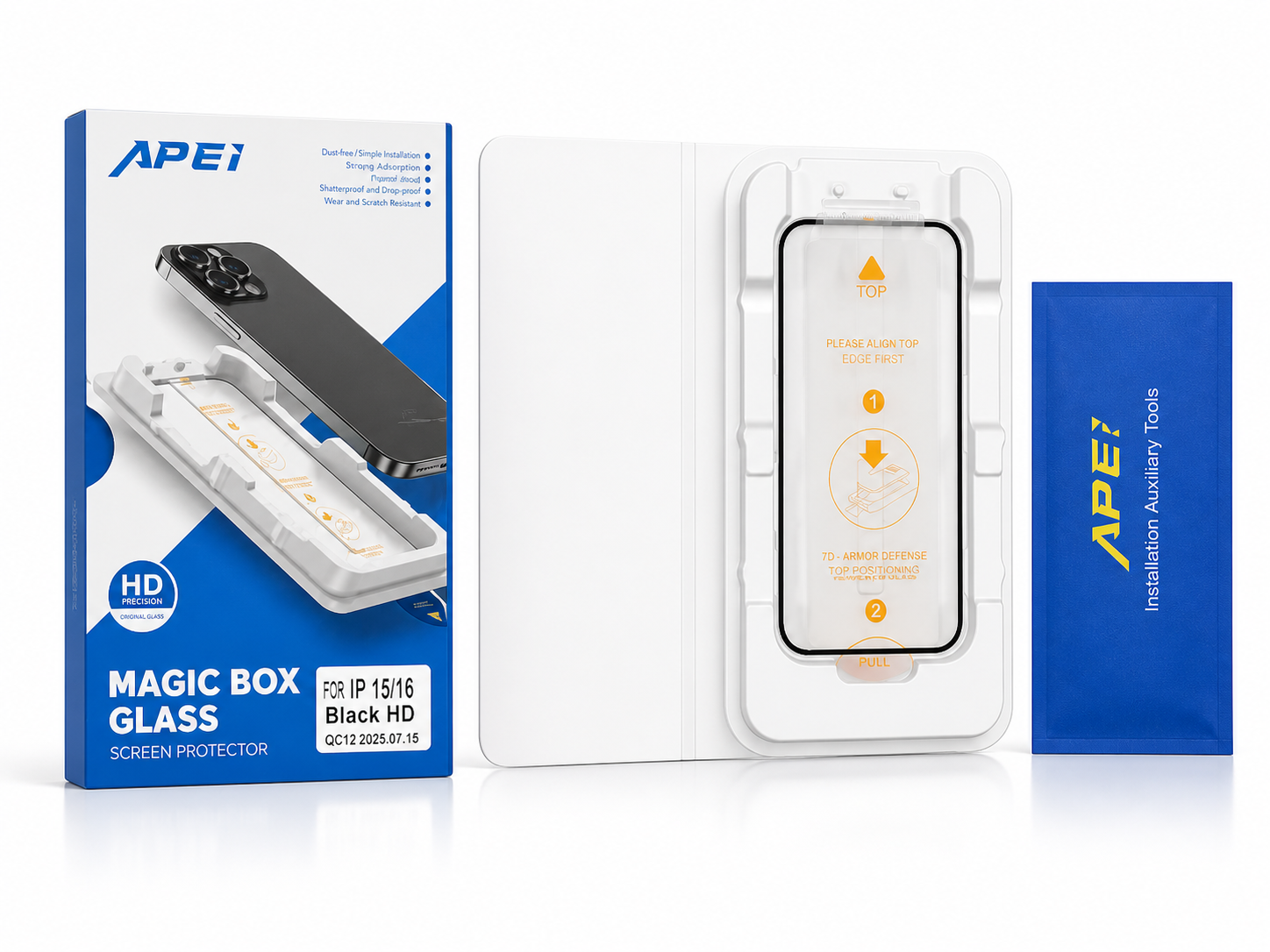
Packaging is not cosmetic. It is commercial. A tempered glass screen protector in a professional retail box with instruction card, cleaning wipes, and dust removal tabs commands a meaningfully higher retail sell price than the same glass in a polybag.A good factory-direct supplier should offer: standard retail box (model-specific), premium kit packaging with accessories included, custom private label packaging for OEM orders, and polybag or bulk pack options for resellers who apply their own packaging.
Know what packaging is available and what it costs. Packaging is additive to unit price — it is not included in the glass cost.
Logistics Capability
Can the factory ship direct to your market, or do you need to arrange a freight forwarder?
Most established manufacturers have relationships with freight forwarding agents and can quote door-to-door for your destination country. This simplifies your first order considerably.
Ask about Incoterms: EXW (you arrange everything from the factory gate) vs FOB (factory loads onto vessel, you arrange from origin port) vs DDP (delivered duty paid — the simplest option for first buyers). DDP pricing gives you a fully landed cost to model against.
How to Evaluate Product Quality Before You Order
Never place a volume order on specification alone.
Request physical samples first. This is standard practice and any credible manufacturer will accommodate it. What to check when samples arrive:
Glass clarity: Hold the protector against a bright screen. Any distortion, hazing, or colour shift is a defect. On anti-glare models, matte diffusion should be even across the surface.
Edge finish: Run your finger around the perimeter. Edges should be smooth and uniform. Sharp edges or uneven bevelling indicate inconsistent manufacturing tolerances.
Oleophobic coating: Touch the surface, then wipe. Fingerprints should clean easily and not leave residue. A weak oleophobic coating degrades quickly in retail use and generates returns.
Adhesive layer: The self-adhesive side should be uniform, dust-free, and bubble-free on application. Peel and reapply once — it should still adhere cleanly.
Drop test (informal): Drop a sample unit face-down from waist height onto a hard floor. This is not a laboratory test, but it gives a basic indication of whether the glass performs at the hardness rating claimed on the box.
Packaging quality: Check box printing quality, insert fit, and accessory completeness. This is what the retailer’s customer opens. It needs to look premium if you are selling it as premium.
Why Factory-Direct Is Not Optional at Scale
At low volumes, the convenience of a trading company or domestic importer is worth the margin cost. The order is simple, the MOQ is manageable, and the relationship is low-commitment.
As volume grows, that convenience becomes expensive. Every percentage point of margin paid to an intermediary compounds across every unit. A distributor moving 5,000 units per month at 15% margin compression from a middleman is leaving significant money on the table every single month.
Factory-direct sourcing is the only model that scales. It gives you pricing control, quality visibility, customisation options, and a direct relationship with the people who actually make the product.
Apei sources and supplies factory-direct. The manufacturing facility in China operates with full QC documentation, machine-applied coatings, and multi-stage inspection before shipment. Wholesale buyers receive factory pricing with no intermediary layer.